Last updated: April 2026
It's official. The European Council gave its final sign-off on 1 April 2026, and the Gibraltar-Spain border treaty will enter provisional operation on 15 July 2026. For La Línea, this is the biggest change to daily life in decades. Here is what it actually means.
Quick Summary
- The treaty takes effect 15 July 2026, confirmed by EU Council on 1 April
- The physical border fence (la Verja) will be removed at the land crossing
- Passport and biometric checks move to Gibraltar's airport and seaport, not the land border
- Spain's Policía Nacional conducts Schengen-style checks at those entry points
- The land crossing at La Línea becomes a joint control zone with drive-through lanes
- Around 15,000 daily cross-border commuters will see the most immediate change
- Gibraltar stays outside the EU and Schengen, but Schengen rules apply at its external border
What Exactly Is Changing on 15 July?
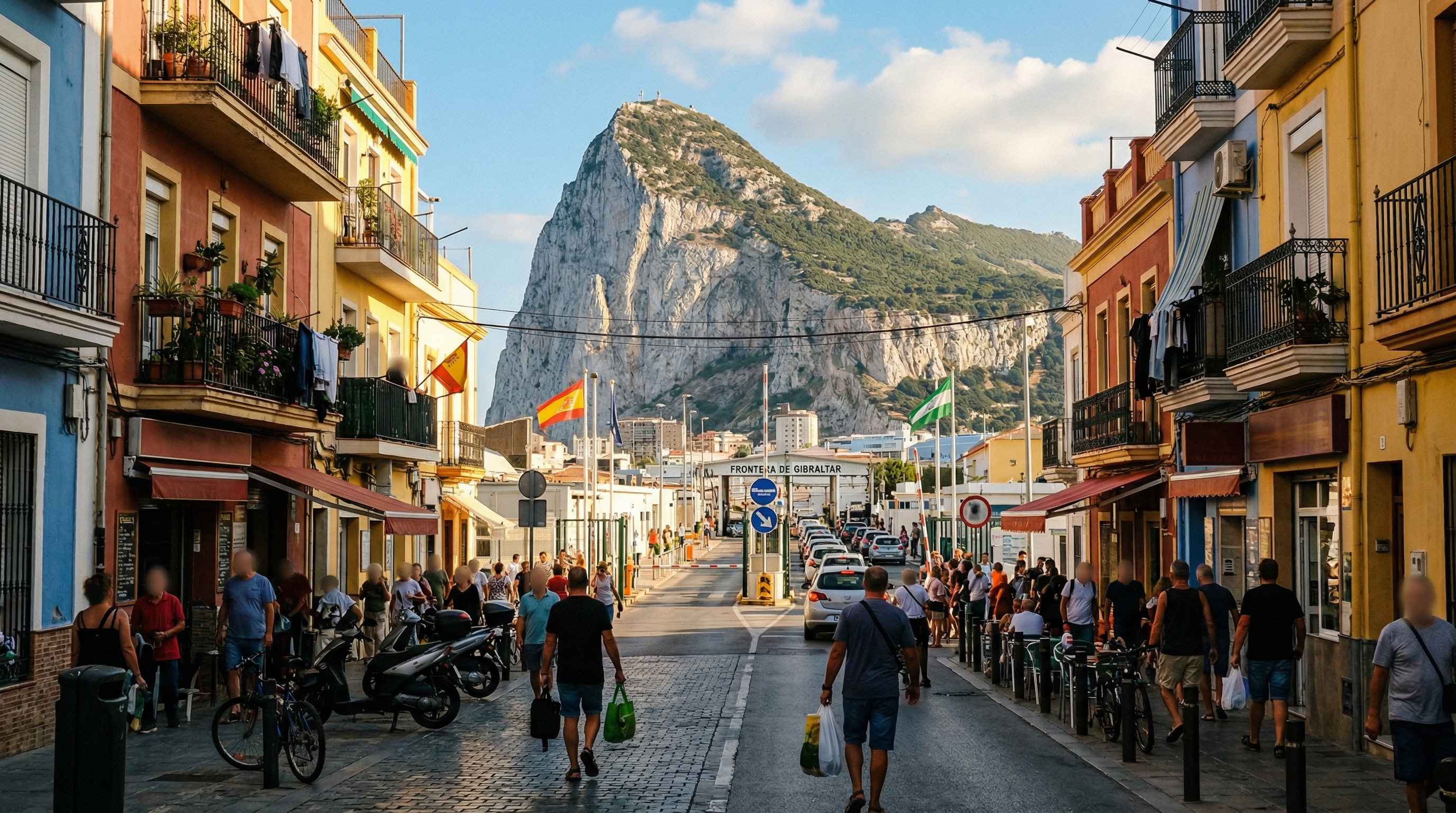
The biggest visible change is at the land border itself. The physical fence, la Verja, which has defined the La Línea-Gibraltar boundary since 1969, will be removed. In its place, the land crossing becomes what the treaty calls a joint control zone, with drive-through lanes replacing the current stop-and-check format.
Passport and biometric checks are moving away from the land crossing entirely. Instead, they will happen at Gibraltar's airport and seaport, where Spain's Policía Nacional will be posted to carry out Schengen-aligned border controls on behalf of the EU. If you enter Gibraltar by air or sea, you go through those checks. If you walk or drive across from La Línea, the land border itself is no longer a hard stop.
The treaty is entering provisional operation, not full ratification. This means it takes legal effect on 15 July but still requires full parliamentary ratification by the UK and EU member states. In practice, the border changes happen on 15 July. The full legal framework is ratified later.
What Does This Mean If You Commute to Gibraltar for Work?
Around 15,000 people cross the La Línea-Gibraltar border every day for work. Most of them are Spanish residents, many of them from La Línea itself. The current reality involves queues that regularly run for 30 to 90 minutes, ID checks at the crossing, and daily uncertainty about how long it will take.
From July 15, the land crossing moves to a drive-through lane model. The biometric and passport check that currently happens at the barrier moves to Gibraltar's port. For most daily commuters crossing on foot or by car from La Línea, the routine will look very different. You will not be stopping for a full check at the land crossing in the same way.
| Now (before 15 July) | After 15 July |
|---|---|
| Passport/ID check at La Verja land crossing | Drive-through lanes at land crossing, no stop-and-check |
| Queues of 30-90 minutes are normal | Land crossing queues significantly reduced |
| Biometric checks not standard at land border | Biometric checks at airport and seaport only |
| Spain's Policía not stationed in Gibraltar | Policía Nacional posted at Gibraltar port and airport |
| Gibraltar outside Schengen, ad-hoc arrangements | Schengen rules apply at Gibraltar's external border |
What Changes for La Línea as a Town?
The treaty doesn't just affect commuters. It changes La Línea's relationship with Gibraltar at a structural level. For decades, La Línea has been the staging post before the border, a place you passed through rather than stayed in. With a genuinely open land crossing, that dynamic shifts.
Businesses in La Línea stand to benefit from Gibraltar workers and visitors spending more time on the Spanish side rather than rushing back through a queued border. Property owners are already seeing this reflected in prices, with Treaty impact posts on this site tracking steady interest from buyers and renters positioning themselves before July.
The town's economy has been quietly preparing. Hotel occupancy is already up compared to the same period last year. New restaurants and bars have opened along the seafront and near the border area in anticipation of increased foot traffic. Local business owners who have been here long enough remember the pre-1969 open border, and some of them are betting on a return to that era.
Gibraltar was never in Schengen to begin with. What the treaty does is apply Schengen border rules at Gibraltar's external border, meaning the airport and seaport. Gibraltar remains a British Overseas Territory outside the EU and outside the Schengen zone. But how you enter and exit the territory is now governed by Schengen-aligned procedures.
What About UK Citizens and Non-EU Visitors?
UK citizens visiting La Línea from Gibraltar are subject to Spain's 90-in-180-day Schengen rule, the same as any other non-EU national. The treaty doesn't change that. What it does change is where those checks happen. Previously, a UK citizen crossing from Gibraltar to La Línea had their documents checked at the land border. Under the new system, the full check happens when they enter through Gibraltar's airport or seaport. Day trips from Gibraltar to La Línea should be simpler in practice.
For non-EU visitors already in Spain, crossing into Gibraltar from La Línea means entering Gibraltar's external Schengen border. Spain's Policía Nacional at the Gibraltar port and airport are responsible for those checks. The land crossing itself is handled differently.
When Will It Actually Feel Different?
Realistically, some things will change on 15 July and others will take months to bed in. The physical removal of la Verja will take time after provisional operation begins. The drive-through lane infrastructure needs to be in place. Spain's Policía Nacional officers need to be fully operational at the port and airport.
Gibraltar's Chief Minister Fabian Picardo described the July 15 date as providing "certainty and additional time to prepare" after the original April 10 date was pushed back. The three-month delay was used precisely to sort out the operational details. By the summer, the expectation from both governments is that the land crossing is physically transformed.
- 15 July 2026: Provisional operation begins, treaty takes legal effect
- Summer/Autumn 2026: Physical changes to the land crossing infrastructure
- 2027 onwards: Full parliamentary ratification by UK and EU member states
The Bottom Line
For La Línea residents, this is decades in the making. The treaty is confirmed, the date is set, and the change is real. If you commute to Gibraltar, life gets easier from July. If you run a business in La Línea, the economic case for being on the Spanish side of a genuinely open border is stronger than it has been in a generation.
Frequently Asked Questions
When exactly does the Gibraltar-Spain border treaty take effect?
The treaty enters provisional operation on 15 July 2026, following EU Council approval on 1 April 2026. Physical changes to the land crossing will roll out from that date through the following months.
Will the queue at the La Línea border disappear completely?
The current stop-and-check format at the land crossing is being replaced by drive-through lanes. Queues are expected to reduce significantly. Full checks will happen at Gibraltar's airport and seaport instead of at the land border.
Does this mean Gibraltar is joining Schengen?
No. Gibraltar remains outside the EU and outside Schengen. The treaty applies Schengen-aligned border procedures at Gibraltar's external border (airport and seaport), but Gibraltar's status as a British Overseas Territory does not change.
What happens to the physical fence, la Verja?
La Verja will be removed as part of the treaty implementation. The land crossing at La Línea becomes a joint control zone with drive-through lanes. The physical removal of the fence will happen after provisional operation begins on 15 July.
Does the treaty affect Spanish residents who work in Gibraltar?
Yes, significantly. The approximately 15,000 daily cross-border workers should see a much smoother land crossing. ID and biometric checks move to the port and airport, so the land crossing stops being a bottleneck for routine daily commuting.