Last updated: April 2026
For most of its modern history, the relationship between La Línea and Gibraltar has been defined by work. Tens of thousands of Spanish residents cross that border every single day to clock in on the British side, then come home to Spain each evening. If you are doing this, or thinking about it, here is what the frontier worker arrangement actually looks like in 2026 — the money, the paperwork, the daily reality.
Quick Summary
- Around 15,000 to 17,000 Spanish frontier workers cross into Gibraltar for work daily
- You pay Spanish income tax on Gibraltar earnings, not Gibraltar tax — this is set by treaty
- The Gibraltar-EU border treaty (expected July 2026) will simplify the crossing significantly
- Gibraltar pays are generally higher than equivalent Spanish salaries, often significantly so
- You need a frontier worker certificate from the Gibraltar Immigration Department to work legally
Who Counts as a Frontier Worker?
A frontier worker is someone who lives in Spain (typically La Línea or the Campo de Gibraltar) and works in Gibraltar, returning home at least once a week. This is a specific legal status recognised under both Spanish law and Gibraltar's own employment framework.
The category covers almost every employment sector: office workers in gaming and finance, hotel and hospitality staff, construction workers, cleaners, port workers, government contractors, healthcare support staff. If you live in La Línea and work across the border, you are almost certainly a frontier worker in legal terms.
How the Border Crossing Works in Practice
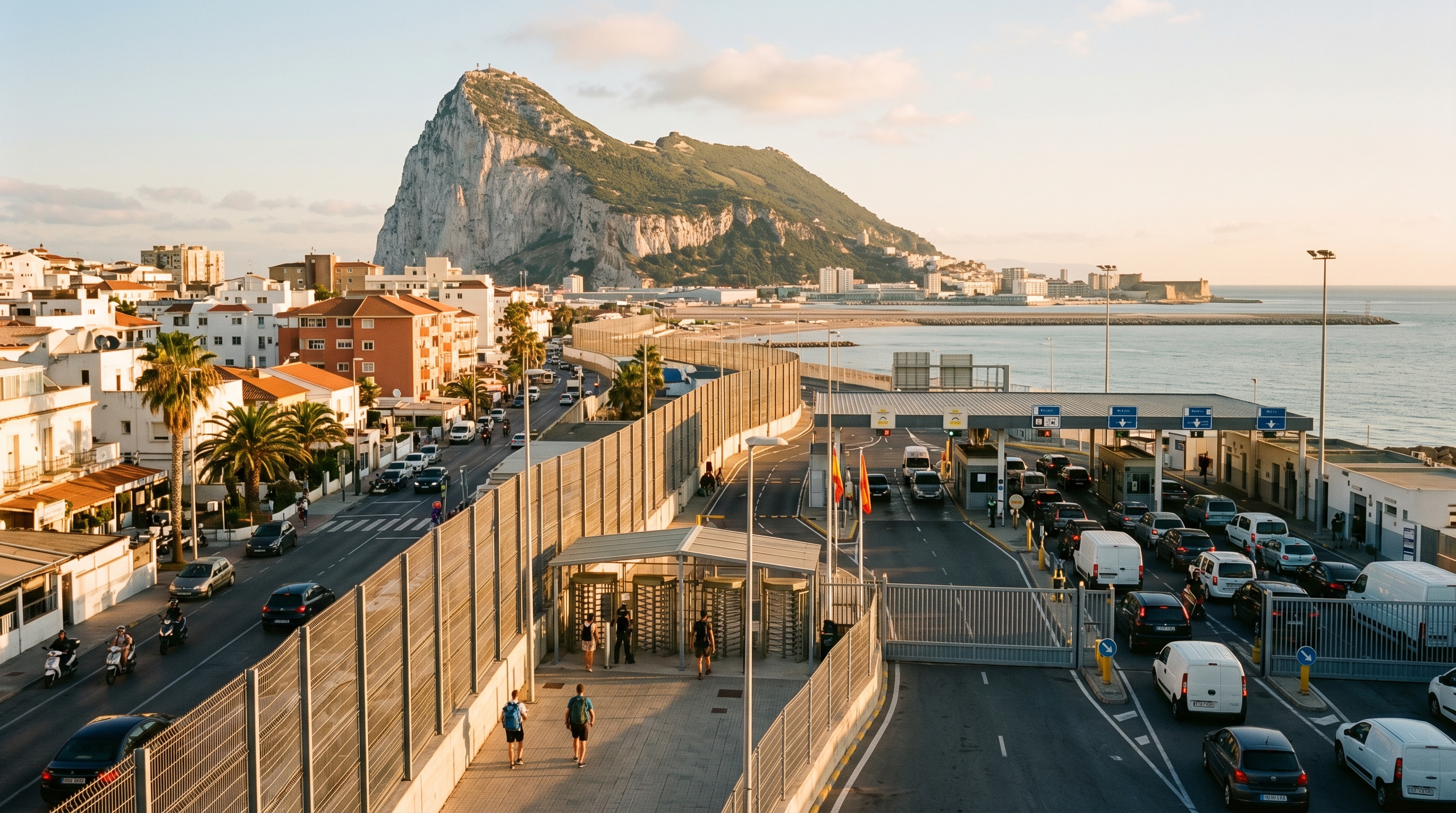
The Gibraltar border operates at Winston Churchill Avenue, the only land crossing. Border control is open 24 hours. On busy mornings — typically 7am to 9am — queues can be significant, especially when vehicle traffic is heavy. Most experienced frontier workers walk or cycle across and leave cars in La Línea.
The Gibraltar-EU border treaty is expected to take effect in July 2026. Under the new arrangement, EU nationals (including Spanish citizens) will be able to cross the border without stopping for checks, using an electronic lane. This should dramatically cut crossing times from the current 15 to 45 minutes down to minutes. For frontier workers, this is a genuinely significant quality-of-life change.
Tax: Where Do You Pay?
This is the most common source of confusion for new frontier workers. The answer is clear but counterintuitive: you pay Spanish income tax on your Gibraltar salary.
Under the existing arrangement (confirmed and carried forward under the new treaty framework), frontier workers are taxed in Spain — the country where they live — not in Gibraltar where they work. You declare your Gibraltar income on your Spanish tax return (declaración de la renta) each year.
| Question | Answer |
|---|---|
| Where do I pay income tax? | Spain (IRPF on your Spanish tax return) |
| Does Gibraltar deduct tax? | No — Gibraltar issues your salary without income tax deduction |
| Do I pay Spanish social security? | Usually Gibraltar social security (check your contract) |
| Do I need to register anywhere? | Yes — Gibraltar immigration and Spanish tax authority (AEAT) |
Given the complexity, most frontier workers use a Spanish gestor (tax advisor) who specialises in cross-border employment. The fee is typically €100 to €200/year and worth every cent to avoid mistakes on your annual return.
What Salaries Can Frontier Workers Expect?
Gibraltar pay rates are generally higher than Spanish equivalents. This is the main reason frontier work is so popular despite the daily commute. The difference can be substantial, especially in sectors like finance, gaming, and skilled trades.
| Sector | Typical Gibraltar Salary (annual) | Comparable Spanish Salary |
|---|---|---|
| Office admin / customer service | £22,000 to £30,000 | €18,000 to €22,000 |
| iGaming / tech support | £28,000 to £45,000 | €22,000 to €32,000 |
| Finance / compliance | £35,000 to £65,000+ | €28,000 to €45,000 |
| Hospitality / service | £20,000 to £26,000 | €16,000 to €20,000 |
| Construction / trades | £25,000 to £40,000 | €18,000 to €28,000 |
What Documents Do You Need?
From Gibraltar
- Work permit / employment authorisation — issued by the Gibraltar Immigration Department, tied to your specific employer
- Frontier Worker permit — confirms your status as a cross-border worker living in Spain
From Spain
- NIE — your Spanish tax identification number (required for filing tax returns)
- Empadronamiento — registration on the La Línea municipal census, proving your Spanish residence
- Spanish bank account — some Gibraltar employers pay into Spanish accounts, and you will need one for tax purposes
The Reality of the Daily Commute
The 10 to 15 minute walk from central La Línea to Gibraltar border control is simple once you know the route. From the border it is another 5 to 15 minutes on foot to most Gibraltar employers, or a short bus ride. Experienced frontier workers have the timing down to a routine.
The main variable is the border queue. Bad days — particularly after bank holidays or during peak summer when visitors are crossing too — can add 30 to 45 minutes each way. Most regular frontier workers build a buffer into their commute time and find it manageable.
Pros and Cons of Living in La Línea and Working in Gibraltar
Why People Do It
- Gibraltar salaries significantly higher than local Spanish rates
- Lower cost of living in La Línea versus Gibraltar (rent, food, utilities)
- Access to Gibraltar's NHS-equivalent healthcare as an employee
- Strong established community of frontier workers — not doing it alone
The Trade-Offs
- Border queue variability adds stress and unpredictability
- Currency risk — paid in pounds, spending in euros
- Spanish tax return complexity (mitigated by using a gestor)
- Limited flexibility to work remotely on days when the border is difficult
The Bottom Line
Living in La Línea and working in Gibraltar is a life that tens of thousands of people have made work for decades. The economics are genuinely good — Gibraltar pay, Spanish living costs — and the July 2026 treaty change should make the daily crossing measurably easier. If you are considering it, get your NIE, register on the padrón, find a good gestor, and talk to the Gibraltar Immigration Department about the work permit process for your specific employer.
Frequently Asked Questions
Can I work in Gibraltar if I am not an EU citizen?
Yes, but the permit process is more involved. Non-EU nationals need a standard work permit rather than the frontier worker arrangement. Your Gibraltar employer typically handles the application. Contact the Gibraltar Immigration Department for current requirements specific to your nationality.
Do I need to speak English to work in Gibraltar?
For most white-collar roles yes — Gibraltar's working language is English. In hospitality, construction, and some service roles, Spanish-speaking teams are common and English requirements may be lower. But for office work in finance or gaming, strong English is expected.
What happens to my frontier worker status after the July 2026 treaty?
The treaty is designed to protect and simplify the existing frontier worker arrangement, not disrupt it. Spanish residents working in Gibraltar retain their right to do so. The main change is the border crossing experience — smoother and faster — not the employment rights themselves.
Where do I find Gibraltar jobs from La Línea?
The Gibraltar Government's job board (gibraltar.gov.gi) lists public sector vacancies. Private sector roles are on LinkedIn, local recruitment agencies like Recruit Gibraltar, and word of mouth. The iGaming and financial services sectors recruit heavily from the Campo de Gibraltar area.