
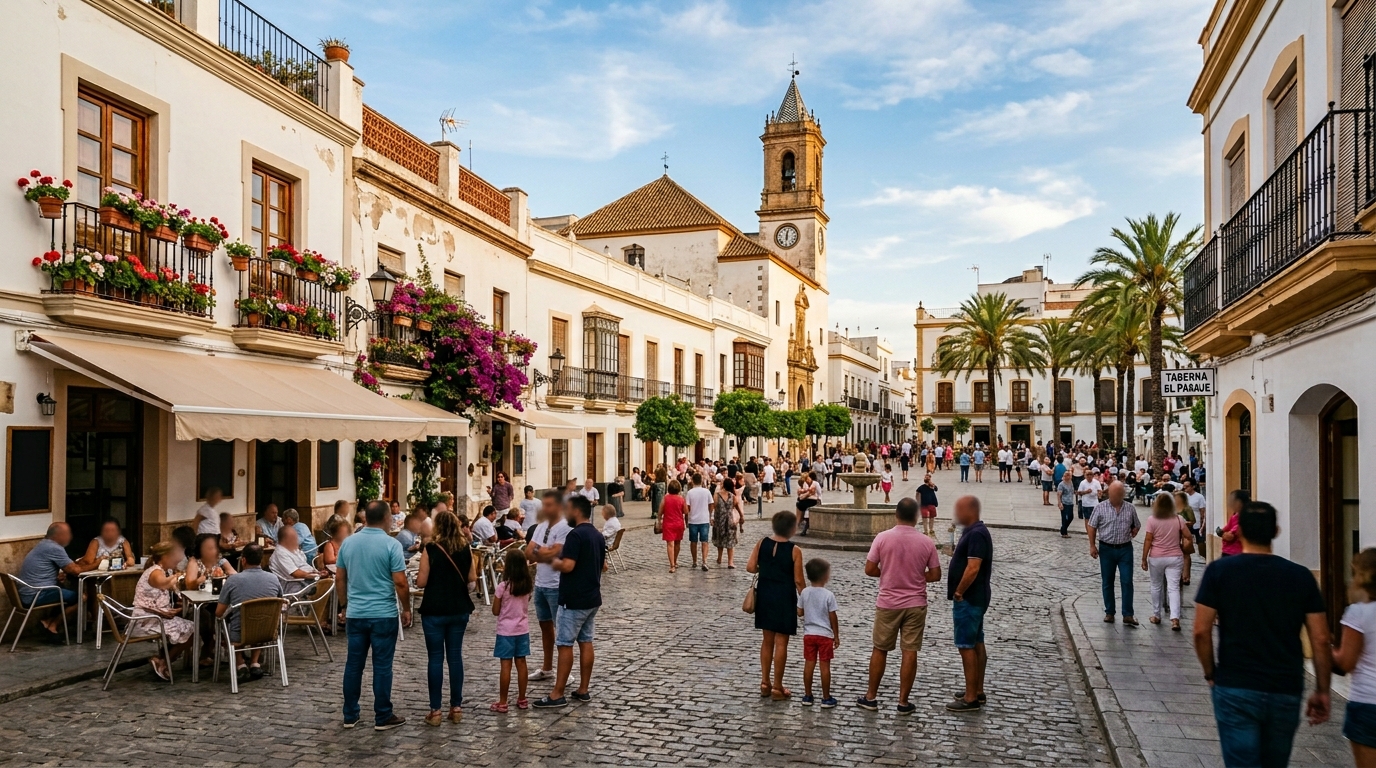
La Línea de la Concepción is a Spanish city of 64,177 people (January 2024, INE) built around the military line marking the Gibraltar border. Founded officially in 1870, it grew from garrison settlements outside British Gibraltar. A new EU-UK treaty with provisional application from 15 July 2026 is set to transform the crossing that has defined life here for three centuries.
Quick Summary
- La Línea was founded in the 18th century after Britain took Gibraltar under the Treaty of Utrecht (1713)
- The border was closed by Franco from 1969 to 1982, splitting families and destroying local livelihoods
- Today around 15,000 workers cross the border daily, making La Línea one of Europe's busiest land crossings
- The EU-UK Agreement on Gibraltar has provisional application from 15 July 2026, removing hard border checks
- The city has a population of 64,177 (January 2024, INE) and sits at the southern tip of Andalusia
How Did La Línea Come to Exist?
The story starts in 1704, when a combined Anglo-Dutch fleet captured Gibraltar from Spain during the War of Spanish Succession. After years of failed attempts to retake the Rock, Spain signed the Treaty of Utrecht in 1713, formally ceding Gibraltar to Great Britain "in perpetuity."
Spain's response was to build a military cordon: a physical line of fortifications and watchtowers along the northern edge of the isthmus connecting Gibraltar to the Spanish mainland. Soldiers and civilians supporting the garrison settled near this line. By the mid-1700s a small town had formed around the military infrastructure, and in 1870 it was officially incorporated as La Línea de la Concepción, meaning "the line of the Conception," named after its military origins and the local patroness.
The town's entire identity, from its street grid to its economy, grew outward from that original military line. Even today, if you look at a map, the border with Gibraltar cuts unnaturally straight across the top of the isthmus. That is the original línea.
The Border Through the Centuries
For most of its history, the La Línea border functioned as a controlled but navigable crossing. Gibraltarians shopped in La Línea. Spanish workers built homes and crossed to the port. The two economies were deeply intertwined.
In June 1969, Franco sealed the border completely, cutting off all pedestrian and vehicle traffic. Thousands of Spanish workers who had been commuting to Gibraltar were suddenly unemployed. Families were split, phone lines cut. The closure lasted 13 years and scarred a generation. La Línea's economy collapsed almost overnight.
Spain reopened the border partially in 1982 (after Franco's death and Spain's transition to democracy) and fully in 1985. By then the damage was done. La Línea had spent 13 years in economic freefall while Gibraltar adapted and built more self-sufficient institutions.
La Línea Today: Key Facts
| Fact | Detail |
|---|---|
| Population | 64,177 (January 2024, INE) |
| Province | Cádiz, Andalusia |
| Area | c.25 km² (public records) |
| Daily border crossings | ~15,000 workers plus tourists |
| Distance to Gibraltar centre | A short walk from the border crossing |
| Patron saint | Nuestra Señora de la Concepción |
| Main fiesta | Feria Real, September |
The Economy: Living in Gibraltar's Shadow
La Línea has long had one of the highest unemployment rates in Spain. At its worst, during the 2008-2014 crisis, youth unemployment reached some of the highest levels anywhere in the country. The city's fortunes are tightly coupled to Gibraltar's. When Gibraltar booms, La Línea benefits through cross-border workers and spending. When the border complicates matters, La Línea suffers disproportionately.
The main economic pillars are:
- Cross-border employment , thousands of linenses work in Gibraltar's financial services, hospitality, construction, and retail sectors
- Commerce , lower Spanish prices attract Gibraltarians for groceries, petrol, hairdressers, and restaurants
- Logistics , the port of Algeciras nearby draws warehousing and distribution activity
- Tourism , budget accommodation base for visitors to Gibraltar and the wider Campo de Gibraltar
The 2026 Gibraltar Agreement: What Changes
The EU-UK Agreement on Gibraltar was published in treaty form on 26 February 2026, received Coreper approval on 1 April 2026, and is set for provisional application from 15 July 2026. This is the most significant change to the border since 1985. The headline effect: the hard border checkpoint between La Línea and Gibraltar is being progressively removed, replaced by a shared Schengen-zone arrangement.
What this means practically:
- EU citizens (including Spanish nationals) can cross into Gibraltar without passport queues under Schengen rules
- The long tailbacks on Winston Churchill Avenue that have defined the border for decades are expected to reduce significantly
- Workers with existing frontier worker permits see their status formalised and protected
- Gibraltar gains access to the EU single market for goods and services in the Campo de Gibraltar area
For La Línea residents, the provisional application date of 15 July 2026 potentially means less time queuing at the border and more economic integration with Gibraltar. Businesses on both sides are cautiously optimistic. The first practical effects are expected to become visible through late 2026 as the new arrangements bed in.
Neighbourhoods and Areas to Know
La Línea is compact enough to walk across in about 30 minutes. The main areas:
- Centro , the old town around Plaza de la Constitución, the main commercial and bar district, with Plaza Cruz Herrera and Plaza Fariñas a short walk away
- La Atunara , the historic fishing quarter near the western coast, known for its authentic seafood restaurants and older architecture
- El Rubio , residential neighbourhood north of the centre, popular with younger families
- La Colonia , the area closest to the border crossing, heavy traffic and commercial activity
- Palmones , technically a separate district but within the municipality, closer to the Bay of Algeciras
What to See and Do in La Línea
La Línea is not a traditional tourist destination, but it has genuine character. The food scene in La Atunara is the real draw. Pescaíto frito (fried fish) is the local speciality, and venues like Mesón La Atunara and La Marina Atunara serve it properly at prices well below what you would pay across the border. For a historic breakfast, Bar Francis is famous across Cádiz province as the inventor of the Africano sandwich, a La Línea institution.
The Museo del Istmo covers the city's unique geographical and historical position on the isthmus, while the Museo Cruz Herrera is dedicated to La Línea's own painter and is worth an hour of anyone's time. For views of Gibraltar and the Strait, the Paseo Marítimo along the beach is a 10-minute walk from the centre. Football fans should know Real Balompédica Linense, known locally as La Balona, founded in 1912 and playing at the Estadio Municipal de La Línea (capacity around 10,800 as of May 2026).
The Bottom Line
La Línea de la Concepción is a city shaped entirely by its relationship with Gibraltar. That relationship has brought trauma (the 1969 closure), dependency (the frontier worker economy), and now, with the 2026 agreement's provisional application date of 15 July 2026, the possibility of something genuinely new. If you are visiting Gibraltar, La Línea is worth at least an afternoon for the food alone.
Frequently Asked Questions
Why is La Línea called "La Línea"?
The name comes from the military "línea," the line of fortifications Spain built along the northern edge of the Gibraltar isthmus after ceding the Rock to Britain in 1713. The town grew from the garrison and support settlements around this military line, and was formally incorporated in 1870 as La Línea de la Concepción.
When was the border between La Línea and Gibraltar closed?
Franco closed the border in June 1969 and it remained shut for 13 years. It reopened partially in 1982 and fully in 1985 after Spain joined NATO and began EU accession talks.
How many people cross the La Línea-Gibraltar border each day?
Around 15,000 frontier workers cross daily, plus tourists and residents. On busy days it is significantly higher. The border is one of the busiest land crossings in Europe.
What is the 2026 Gibraltar Agreement and when does it apply?
The EU-UK Agreement on Gibraltar integrates Gibraltar into the Schengen area for border crossing purposes. The treaty text was published on 26 February 2026, received Coreper approval on 1 April 2026, and has provisional application from 15 July 2026. EU citizens can cross without hard border checks, and Gibraltar gains single market access in the Campo de Gibraltar zone.
Is La Línea safe for tourists?
The city has a mixed reputation, but the town centre and tourist areas are perfectly safe during normal hours. Use common sense at night, as you would in any city. The beaches, restaurants, and waterfront are well worth visiting.