
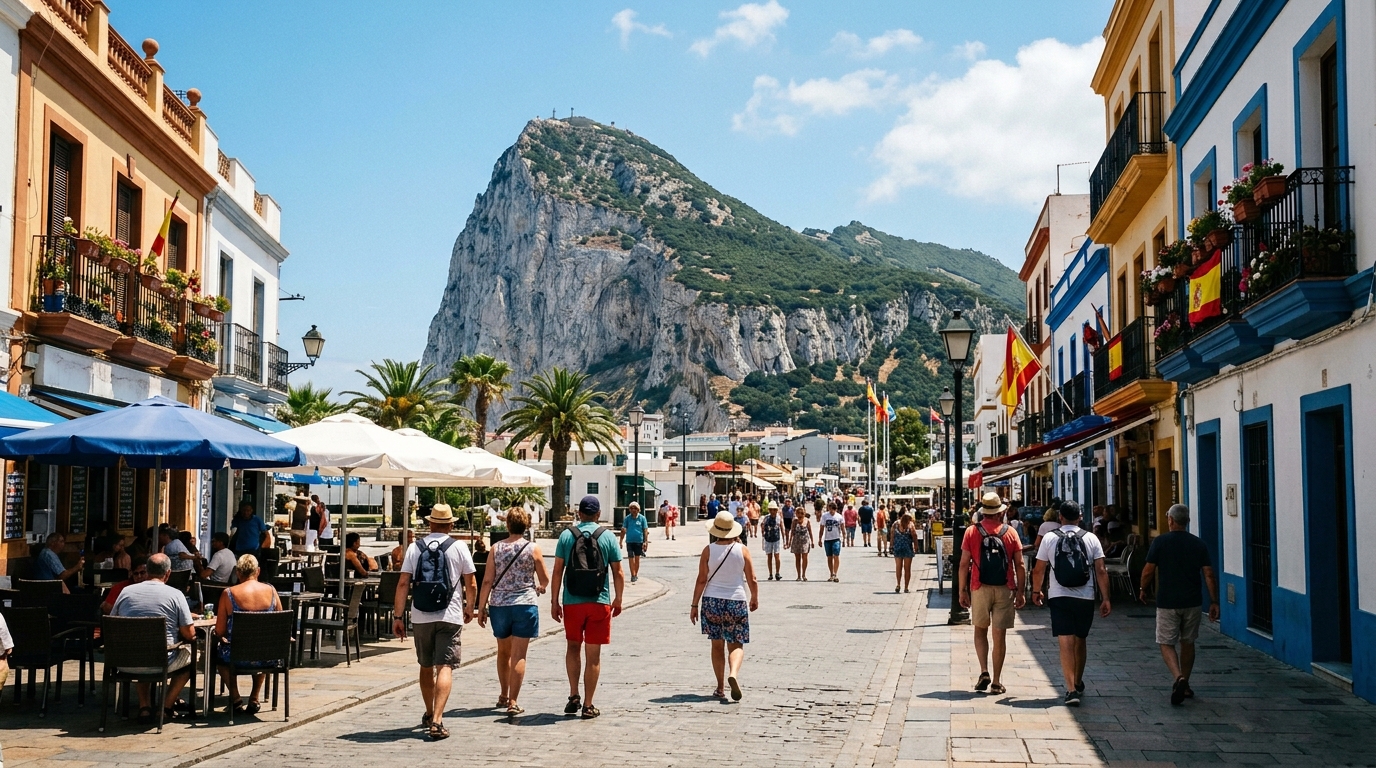
The Gibraltar border treaty enters provisional application on 15 July 2026. From that date, the land frontier fence between La Línea and Gibraltar will be removed, routine land crossing checks will end, and Schengen-style border controls will shift to Gibraltar's airport and seaport. Around 15,000 daily cross-border workers will benefit most.
Quick Summary
- EU member states unanimously backed the Gibraltar treaty on 1 April 2026, with 15 July 2026 as the provisional application date (as of May 2026)
- The border fence (La Verja) will be removed at the land frontier between La Línea and Gibraltar
- Physical checks at the land crossing end. Spanish Policía Nacional will carry out Schengen checks at Gibraltar's airport and seaport instead
- Gibraltar stays outside Schengen but Schengen border rules apply at its external entry points
- Around 15,000 frontier workers crossing daily will see the biggest practical change
- Full ratification by UK, Gibraltar and EU parliaments comes later. 15 July is provisional application only
Why July 15 and Not April 10?
The original proposed date was 10 April 2026. That date slipped after legal-linguistic reviews took longer than expected, and both sides decided it made no sense to start the new border system just before the peak Easter and summer travel period. Moving to 15 July gives agencies and businesses extra time to prepare and avoids rolling out a new border model when queues are already at their worst.
Gibraltar's Chief Minister described the revised date as providing certainty and breathing space. From La Línea's perspective, that breathing space has been useful. Local employers, landlords, and commuters have had more time to understand what is actually coming.
This is when provisional application of the treaty begins. Schengen-style border controls kick in at Gibraltar's airport and seaport. The land frontier between La Línea and Gibraltar changes fundamentally from this date.
What Physically Changes at the Border?
The most visible change is the removal of the land frontier barrier, known locally as La Verja. This fence, built in 1969 during the Franco era, has been a physical symbol of the territorial dispute between Spain and the UK over Gibraltar. Under the treaty, it goes.
At the land crossing, the aim is a much smoother flow of people. No more stopping at a checkpoint for every person crossing on foot or by car. The friction point moves to the external entry points at Gibraltar's airport and seaport, where Spanish Policía Nacional officers will work alongside Gibraltar border agents in a juxtaposed arrangement, similar in concept to how Eurostar border controls work.
| Before 15 July | After 15 July |
|---|---|
| Land border checks for everyone crossing | No routine checks at the land frontier |
| La Verja fence in place | La Verja removed |
| Gibraltar outside Schengen, visible at the crossing | Schengen rules applied at airport and seaport |
| Queues at the Gibraltar/La Línea land crossing | Frontier intended to flow much more freely |
| Spanish police present at the Spanish side only | Spanish police working inside Gibraltar at port and airport |
What Changes for Daily Frontier Workers?
This group feels the change most. Around 15,000 people cross that border every working day (as of 2026), most of them La Línea residents heading into Gibraltar to work in hospitality, finance, retail, construction, and gaming. The queue at the crossing has been a daily source of frustration for years. On bad days it runs to 90 minutes. On better days it is still 20 to 30 minutes of standing in line regardless of the weather.
From 15 July, routine checks at the land frontier end. That does not mean zero friction forever, border agencies will still be watching for specific threats, but the mass-queuing system for standard commuters should change significantly.
For frontier workers, the practical benefit is straightforward: more time at home, less time at the border. The Gibraltar economy depends on this workforce, and so does La Línea's. If crossing becomes genuinely easier, expect more people to take jobs in Gibraltar without viewing the commute as a daily tax on their time.
Nothing urgent before 15 July. Keep your current work permits and documentation in order. Updated guidance on the new crossing process for registered frontier workers is expected from the Gibraltar government as July approaches.
Does Gibraltar Join Schengen?
No. This is worth being clear on because it gets confused regularly.
Gibraltar remains outside the Schengen Area. It also remains outside the EU. What the treaty does is apply Schengen external border rules at Gibraltar's entry points, specifically the airport and the seaport. Spanish police will carry out these checks. But Gibraltar itself is not in Schengen; it is following Schengen border management practice at its external points of entry.
For La Línea residents who travel frequently, this distinction matters mainly when returning from non-Schengen destinations. The land frontier between La Línea and Gibraltar becomes the easy part. The airport in Gibraltar is where the Schengen framework actually applies.
What About the Spanish Political Row?
Spain's opposition parties have argued that the agreement needs to be ratified by the Spanish parliament rather than approved solely at the European level. Spain's Foreign Minister has pushed back on this, describing it as an EU association agreement with a third country that does not require a domestic parliamentary vote.
This matters for La Línea residents because a contested ratification process in Spain could create uncertainty. The treaty starts provisionally on 15 July regardless of this debate. But full permanent ratification depends on both EU and UK legislative processes completing, and the Spanish political argument is a background risk that could complicate the longer-term picture.
In practice, 15 July is happening. The EU green-light was formal. The debate about ratification routes concerns permanent implementation further down the line, not the provisional start date.
What This Means for La Línea Economically
La Línea's economy is closely tied to Gibraltar's. When the border is difficult, it suppresses economic activity. Businesses on the La Línea side that serve Gibraltar workers, bars, restaurants, supermarkets, and services, do well when people cross freely and less well when crossings are stressful.
Easier movement in both directions should bring more Gibraltar residents and visitors into La Línea. If you are running a business in the centre of La Línea or near the border area, 15 July is a date to be ready for. The city has historically undersold itself to Gibraltar-based visitors who found the crossing not worth the hassle for a quick lunch or a browse around the Mercado Municipal de Abastos on Calle Isabel La Católica.
What Stays the Same
- Gibraltar's sovereignty status remains unchanged. It is a British Overseas Territory. This treaty does not address the sovereignty question at all.
- La Línea remains in Spain and in the EU. Spanish law applies. Schengen residency and movement rights are unchanged for La Línea residents.
- The Gibraltar pound and the euro remain separate currencies. You will still want to check your pocket before crossing if you rely on cash.
- Property ownership rules on both sides remain the same.
- Employment rights for frontier workers are governed by existing frameworks, though these may be updated over time as the treaty fully takes effect.
The Bottom Line
15 July 2026 is a genuinely significant date for La Línea. The fence comes down, the land crossing changes fundamentally, and the daily friction of the commute is supposed to get better. The economic and social knock-on effects for the city will take months and years to play out, but the direction is clear. For anyone living here, working in Gibraltar, or thinking about moving to the area, this is the border reality from mid-July onwards.
Frequently Asked Questions
Does the July 15 treaty mean I can cross into Gibraltar without showing ID?
The land frontier checks change significantly, but Gibraltar retains its own border authority. While routine stopping should reduce dramatically, it is worth keeping identification on you when crossing. The system is new and procedures will take time to settle.
I'm a La Línea resident who works in Gibraltar. What do I need to do before 15 July?
Keep your frontier worker documentation current. No major action is needed immediately. Closer to 15 July, the Gibraltar government will publish updated guidance on what the new crossing process looks like for registered frontier workers.
Will property prices in La Línea go up because of the treaty?
Early market signals suggest yes, though modestly. Easier access to Gibraltar makes La Línea more attractive for Gibraltar workers to live in. Rents in particular have been rising in anticipation of improved connectivity.
Does this affect my rights as a Spanish citizen living in La Línea?
Your rights as a Spanish and EU citizen are unaffected. The treaty governs Gibraltar's border arrangements. Spain and La Línea remain firmly in the EU and Schengen, with all the rights that come with that.
When is full permanent ratification expected?
Full ratification by the UK, Gibraltar and EU parliaments is a separate process from the provisional application starting 15 July. No confirmed timeline for full ratification has been announced. Provisional application can run for an extended period while the ratification process continues.